When Is The Right Time for an Older Adult to Move From a Longtime Home?

When is the right time to move an elderly parent to a more suitable home?

Life transitions can be difficult on many levels but help is available.

Many families throughout San Francisco and Sonoma County eventually face the challenge of helping an older loved one move to a safer and more supportive living situation. When that moment arrives, some of the first questions are often the toughest:

What’s the right living situation for mom/dad now? What should we do with the family home? The house is full of stuff, what do we do with it all? It seems overwhelming, where do we start?

Helping an aging parent or loved one move is very different from a typical real estate transaction. It is rarely just about selling a house. It often involves safety concerns, emotional decisions, and family members trying to determine what is best for someone they care about.

For many families, the process begins after a triggering event such as a fall, a health change, or the gradual realization that maintaining a longtime home has become too difficult.

Safety and Practicality Come First

The most important question is whether the home is still safe and manageable. Stairs, large properties, deferred maintenance, and complex layouts can become increasingly difficult for someone living alone.

In many cases, a more suitable housing option may be a single level condo, a smaller home closer to family, or a senior living community that provides additional support and services.

Timing Is Often Challenging

Families frequently wait until a situation becomes urgent. When possible, planning earlier allows time to evaluate options, prepare the home properly for sale, and make thoughtful decisions rather than reacting under pressure.

Selling a Long-Held Family Home Is Different

Homes that have been owned for decades often require a different approach. There may be accumulated belongings, older systems, or deferred maintenance. Determining what improvements are worthwhile and what should remain as is can have a meaningful impact on the final result.

A thoughtful strategy helps families avoid unnecessary work while still positioning the home to achieve the best outcome.

Experience Matters

Moves involving seniors often require coordination with family members, financial advisors, attorneys, and care professionals. Clear communication and careful planning can make a meaningful difference during what is frequently a sensitive and emotional transition.

As an SRES Seniors Real Estate Specialist with 23 years of experience, I help families navigate these situations with care, discretion, and practical guidance. From San Francisco to Sonoma Wine Country, I work with families making the move from a longtime home to the next chapter, always with patience, compassion, and a clear plan.

If your family is beginning to face these decisions, speaking with an experienced professional can be a helpful first step. Please feel free to call or email me for a no-obligation consultation.


Why Online Home Value Estimates Are Frequently Wrong

Online home value estimates are everywhere. They are easy to find and tempting to trust. For many buyers and sellers, they feel like a definitive answer. Unfortunately, they are often wrong. Sometimes slightly. Sometimes by a wide margin.

Here’s why…

Algorithms Don’t Physically Visit the House

Online valuations are driven by algorithms. Those algorithms rely on public data such as recent sales, square footage, bedroom counts, and general neighborhood trends. What they cannot see is often what matters most.

They do not see light, layout, privacy, condition, quality of renovation, or how a home actually feels. They cannot tell the difference between a dark north facing unit and a bright one with open exposure. They do not know whether a backyard is usable or awkward. They cannot judge noise, slope, or how a floor plan lives day to day.

In markets like San Francisco and Sonoma County, these factors can move value significantly.

Algorithms average, they don’t evaluate

Most online estimates work by averaging nearby sales and adjusting based on basic attributes. That approach assumes homes are interchangeable. In reality, they are not.

Two homes on the same block with the same square footage can have very different values due to block position, condition, views, or even micro location. Algorithms struggle with these nuances, especially in older housing stock and mixed neighborhoods.

The result is often a number that looks precise but lacks context.

Algorithms lag the market

Online valuations are reactive. They rely on closed sales, which reflect pricing decisions made weeks or months earlier.

In a rising market, online values often trail reality. In a shifting or softening market, they can overestimate value and create unrealistic expectations. Either way, they are behind what buyers are actually willing to pay today.

This matters when timing and pricing strategy are critical.

Algorithms ignore buyer psychology

Value is not just data. It is also psychology.

How a home is positioned, priced, staged, and presented affects how buyers respond. A well priced home that creates urgency can outperform expectations. A home priced too high can stall, even if the online estimate supports it.

Algorithms do not understand momentum, emotion, or competition. Buyers do.

Algorithms can create false confidence or false anxiety

For sellers, an inflated online value can lead to overpricing and missed opportunities. For buyers, a low estimate can cause hesitation or fear of overpaying, even when the home is correctly priced.

In both cases, the number becomes a distraction rather than a useful tool.

What to rely on instead of an algorithm

Online values are not useless. They can provide a very rough starting point. The mistake is treating them as an answer.

A more reliable approach combines:

Recent comparable sales, adjusted thoughtfully.

Current buyer demand.

Micro location insight.

Condition and presentation.

Market timing.

The experience and local knowledge of a reputable agent.

The Bottom Line

Online home values are designed for scale, not accuracy. They are built to estimate broadly, not advise personally.

When real money, real timelines, and real decisions are involved, context matters more than convenience.

Whether you’re considering selling or buying, if you are trying to understand what a home is truly worth in San Francisco or Sonoma Wine Country, I am always happy to help.

The outlook for the 2026 real estate market

Predictions for the 2026 real estate market

2026 marks a step toward a more balanced market. After four years of pandemic-driven extremes, including frozen migration, volatile mortgage rates, major affordability challenges, and uneven supply across regions, the U.S. housing market enters a new era.

We expect the market to begin a new phase of improved affordability, not through a dramatic price correction, but through an extended period of flat home prices, rising incomes, and gradually falling mortgage rates.

The expensive mistake that many home sellers make

One of the biggest, and most costly, mistakes sellers make is setting the list price too high. Overpriced homes linger on the market, invite price cuts, and usually end up selling for less than if they had been priced right from the start. Pricing your home correctly from day one is critical.

Why days on market matter

The “days on market” counter is visible to every buyer online. When a listing sits unsold, buyers start to assume the home is overpriced or has issues. Each extra day weakens a seller’s position and shifts leverage to the buyer.

What happens when you miss the mark

Overpricing creates opportunities for buyers. Experienced buyers watch for stale listings and price drops, then step in with low offers when competition has faded. That puts sellers at a disadvantage during negotiations.

The myth of underpricing

Sellers sometimes worry about underpricing, I get it, but the risk is quite low. You’re never obligated to accept any offer at any price. If the price attracts strong interest, buyers compete and push the final price higher. You stay in control.

The bottom line

The market ultimately determines the price, not the seller and not the agent. Setting an attractive list price from the beginning invites conversation from prospective buyers and creates the conditions for the strongest offers and terms.

Ready to talk about potentially selling your San Francisco or Wine Country home? Reach out anytime and let’s discuss our 3-Phased Marketing Strategy to see if it is the right approach for your situation.

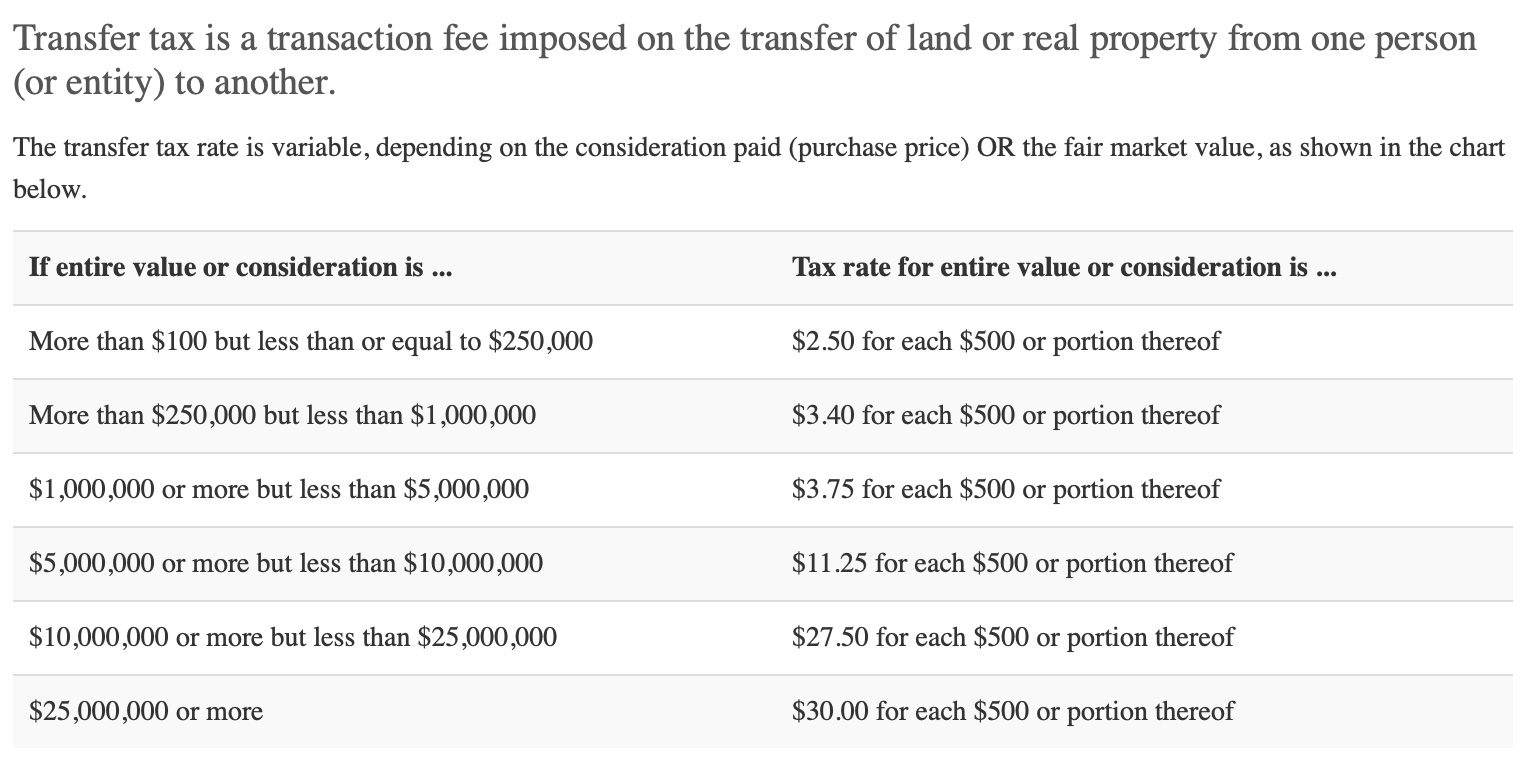
San Francisco Real Estate Transfer Tax

Sellers have many things to consider when they prepare to sell their home or condo. One of the expenses that can surprise some sellers is the City & County of San Francisco Transfer Tax. This hefty tax is based on the sales price and is deducted from your proceeds by the escrow company. In transactions involving new construction properties, buyers are generally required to pay this tax.  (Updated March 2022)

How much can you expect to pay in transfer tax?

What is a contingency when buying a home in San Francisco?

If you’ve been looking for real estate in San Francisco, you have probably heard the term “contingency”; it means “dependence on the fulfillment of a condition”. In the world of SF real estate, a contingency is simply a period of time in which the buyer can investigate a property or mortgage loan while still protecting their deposit.

Contingencies are sometimes used for property inspections like a termite inspection. Other contingencies are for mortgage loan approval, appraisal, or the sale of another property. Sellers can have have contingencies too, like finding a replacement property, but buyer contingencies are more common.


parachute

In this very frenzied seller’s market, any buyer contingency can give the seller some pause when they are considering whether to accept an offer.

It can be challenging for buyers to protect their interests while still getting their offer accepted. As I’ve written about before, disclosures are important. Seller disclosure packages (complete with inspection reports) allow the buyer to be reasonably informed about the property at the outset before submitting an offer.

Regardless of disclosures, some buyers opt to roll the dice and waive all contingencies as a strategy to make their offer more attractive to the seller. Buyers should be aware that waiving contingencies is risky. As usual, it boils down to risk tolerance and of course every buyer (and every property) is unique.  If you are considering buying or selling, let’s talk about how contingencies might impact you.

From SF to Wine Country (and everything in between)

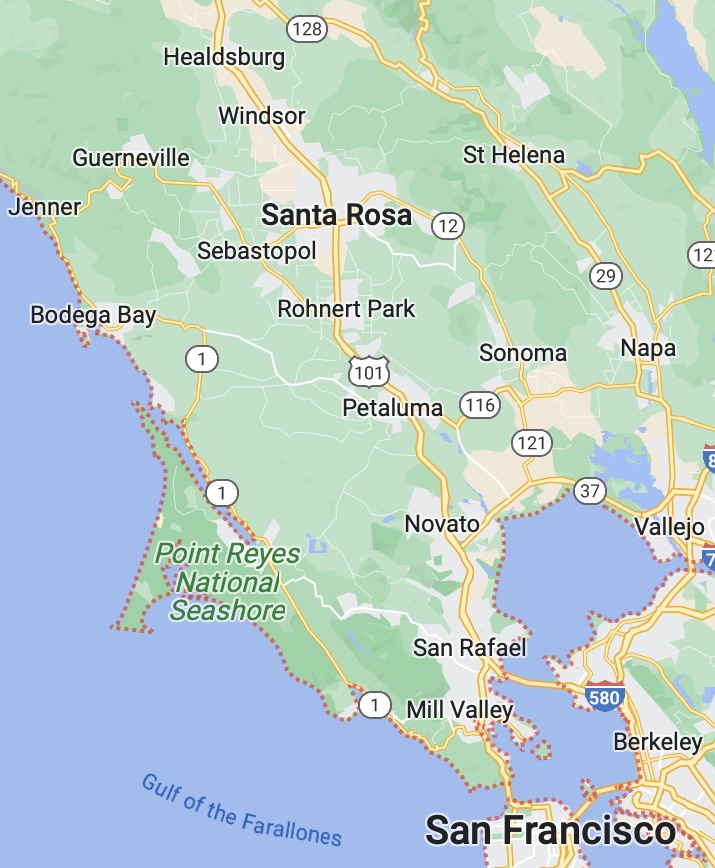
For more than a decade, I’ve been incredibly fortunate to have had the opportunity to represent many home buyers and sellers throughout San Francisco. My real estate business has grown exponentially since that time as clients have called upon us to represent them in nearby counties. As a result, my team and I are excited to now include Marin & Wine Country in the areas that we serve.

In addition to San Francisco, we represent real estate clients in Healdsburg, Sonoma, Santa Rosa, Guerneville, Petaluma, Windsor, Occidental, Sebastopol, Napa, St Helena, Calistoga, Yountville, Novato, Mill Valley, San Rafael and surrounding towns. If you are considering buying or selling a home in Wine Country, Marin, or San Francisco, my team and I are here and ready to help!

Now representing clients in San Francisco, Marin, Sonoma, and Napa

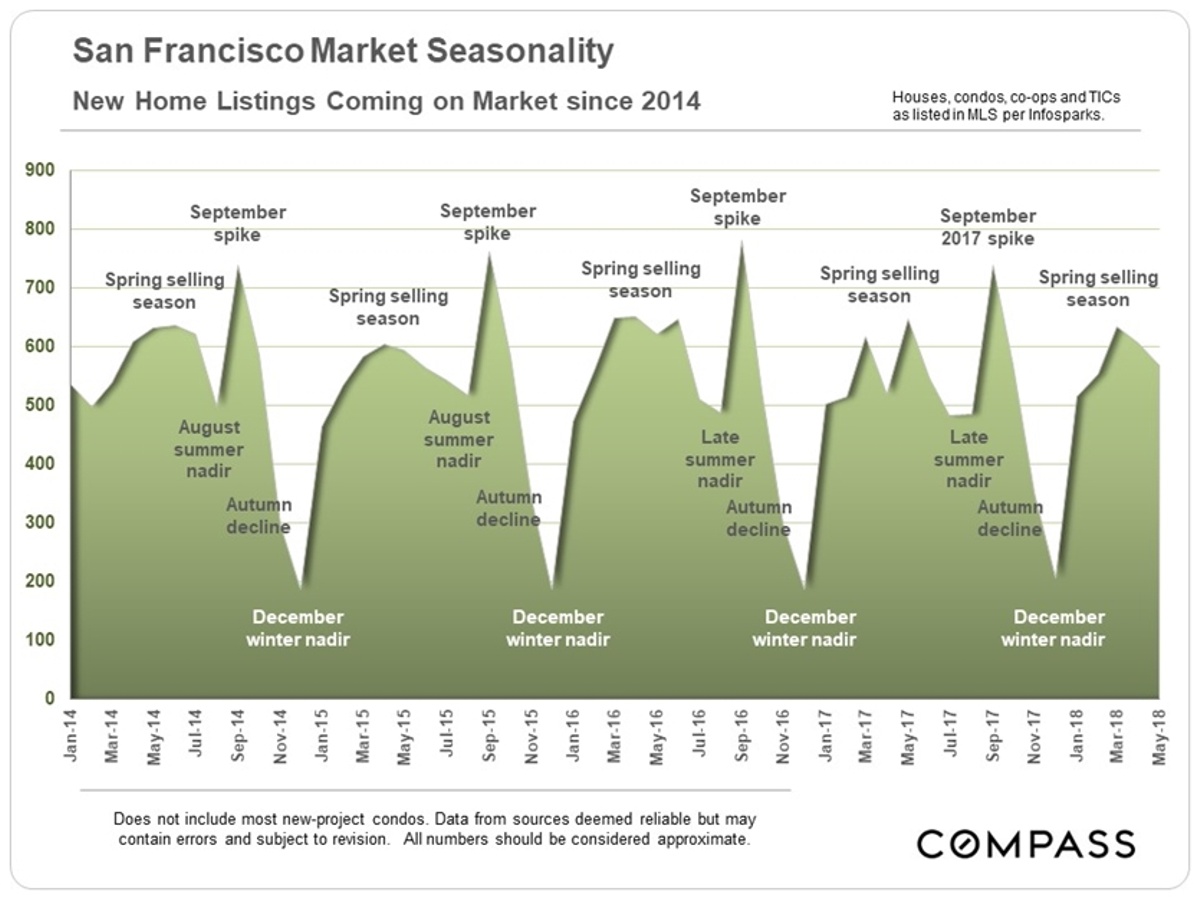
When is the best time of year to buy or sell a home in San Francisco?

I am often asked about the seasonality of real estate in San Francisco. As it has been for a long time, we are in a seller’s market in SF however there are definitely some fluctuations throughout the year.

Sellers: The majority of the year is still very good for sellers, especially for single family homes, however the best time for sellers is in September/October when the weather is usually sunny and dry and fog is nowhere to be seen. This time of year is known as “San Francisco’s summer” even though it is really autumn everywhere else. Throngs of buyers are visiting lots of open houses on these sunny weekends, multiple offers are the norm, and sale prices that far exceed list prices are very common.

Buyers: If you are buying and want to have a shot at getting a (relative) bargain, you’ll want to do that in July/August or wait until November/December (but the number of available listings will be limited). The number of buyers that you’ll compete with are usually relatively low at this time, and the resulting number of offers and sale prices will also likely be in your favor. Of course, as with most things in San Francisco, each neighborhood and price range has it’s own unique nuances, so please let me know if you need advice on your particular situation.

4 tips for selling your home in San Francisco

It’s no secret that we’re in a seller’s market right now. Limited inventory, competing buyers, and multiple offers above list price seem to be the new normal. This will certainly change as the market goes through its normal cycle but for now things are clearly favoring sellers. Despite the current robust market, sellers still need to be very careful as they prepare to sell their home. Here are my suggestions for getting your home or condo sold for the highest price possible:

1.  Your home should be vacant and staged.
It is important that buyers can envision themselves living in your home, instead of being reminded by visual queues that you live there. Staged homes typically fetch higher sale prices that non-staged properties. I understand that moving out and staging is sometimes not feasible, but at a minimum the home should be freshly painted, in reasonably good condition, clean and clutter-free.

Untitled Infographic2.  Do not overprice your home.
The best marketing in the world will not sell an overpriced home, even in a seller’s market. Most sellers have an almost irresistible desire to slap a sky high price tag on their home. Like most things in San Francisco though, real estate works a bit differently here compared with other cities. In the majority of SF neighborhoods right now, it’s customary to list your home a bit lower than you expect to actually end up with. Assuming the market demand warrants it, an offer date is set.  That date is essentially an engraved invitation to buyers to make their highest and best offer. Real estate guru Barbara Corcoran said it best: “Don’t ever be afraid of underpricing your home, because market forces always correct an underpriced property. It’s called a bidding war, and you’ll be smiling when it starts.” If you’re worried that you’ll be forced to accept a low offer, don’t stress. In San Francisco, you are never obligated to accept any offer at any price until you actually accept it. There are many exceptions to this strategy, it does not apply to all homes, all sellers, or all neighborhoods. Carefully consult with an experienced broker on this.

3. Disclose. Disclose. Disclose.
Selling a home can be a litigious minefield. Buyers sometimes claim that they were misled by sellers who did not reveal all they knew about a home. There’s a simple way to avoid much of this risk though, since the only buyers who sue sellers are surprised buyers.  If you are selling your home, you are required by law to document any material facts in advance of the sale. Disclose everything that might surprise a reasonable person if they were to learn it after the sale was over. Every home and neighborhood has some degree of imperfection, especially in San Francisco. A crack on a wall, chipped paint on a doorframe, an appliance that is not working properly, a constantly barking dog next door, the stolen bike from your garage last year, a noisy freeway nearby, etc.  Will a list of negatives turn off a motivated buyer? Highly doubtful. In fact your thorough disclosures tell buyers that you are forthcoming and diligent. This potentially could result in a higher offer because buyers will likely feel more informed, more comfortable, and less apprehensive about the purchase.

Real-estate-seller-disclosure

4. Hire an experienced real estate broker who knows the local market.

Are you working with an experienced licensed broker? How long has he or she been selling homes? Can they provide testimonials from past clients? Do they have a professional web site and a solid online presence? This person is representing you (and probably your biggest financial asset) so make sure to do your homework.  Of course, if you are thinking of selling,  I’d love to have a chance to go over my proven marketing plan with you before you list your home.

I’ve represented many sellers over the years so I have plenty of additional tips to share. Just call or email me.